

Edge AI-driven command center cuts worker accidents by 99% for a global ports operator
Overview
We helped a global ports operator move beyond manual surveillance across thousands of cameras, replacing it with an AI-driven command center that detects risk in real-time and extends safety oversight to IoT-connected reefer containers and other site assets.
Key outcomes at a glance:
- 99% reduction in worker accidents, moving the operator toward a near-zero fatality outcome across its sites
- 15x more safety and security incidents detected through AI-driven monitoring, compared with manual surveillance
- 75% reduction in costs and losses tied to safety, security and HSE incidents
The Challenge
Monitoring thousands of cameras manually made security and surveillance costly, slow and difficult to scale.
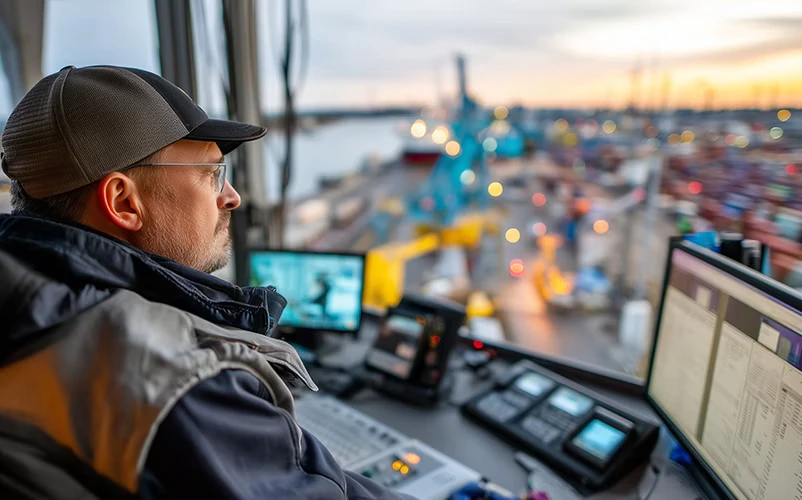
Specific challenges included:
- Significant cost of staffing security and surveillance operations across multiple sites
- Manual monitoring delayed incident detection and slowed response to safety, security and Health, Safety and Environment (HSE) risks
- Financial exposure from a single safety or asset incident running into millions, with multi-year replacement lead times on critical equipment
- Regulatory risk from undetected speed violations and restricted-zone breaches that could trigger operational shutdowns
- No unified way to integrate IoT sensor data, including reefer container monitoring, into daily operations
Ultimately, relying on people-intensive processes limited the operator's ability to scale the required safety, security and HSE protocols across a growing number of sites.

The Objective
The operator needed a single AI-driven platform that could monitor every site in real-time, integrate IoT sensor data and scale without adding headcount.
The goal was to replace fragmented, manual oversight with a model where AI handled detection and people focused on response- giving the operator real-time visibility to protect its workforce, contain costs and meet regulatory obligations consistently across its growing estate.
The Solution
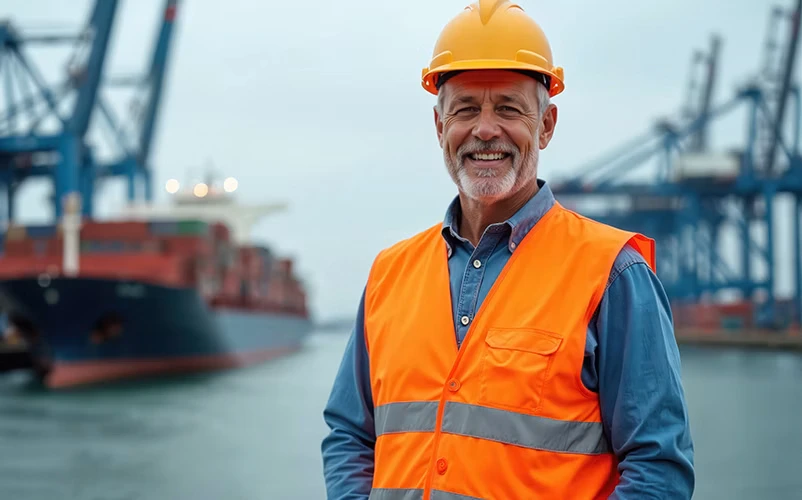
We deployed our HCLTech VisionX platform, built with NVIDIA Metropolis, creating an AI-driven command center that gives the operator real-time coverage of people, vehicles and assets across every site.
Rather than replacing existing infrastructure, we layered Edge AI on top of it -processing risk at the point of origin and validating incidents before they triggered alerts. The platform scaled from existing cameras to IoT sensors and private 5G connectivity, all managed through a single operational view with enterprise-grade security built in.
- Multimodal AI detection models: AI models trained on people, vehicles and asset movement across port environments, continuously refined to reduce false alerts
- Edge AI integration layer: Real-time inference at the source, eliminating cloud latency for time-critical safety and security decisions
- IoT and connectivity integration: Private 5G network and GNSS positioning extend monitoring to reefer containers and site-wide sensor networks
- AI-driven command center: Centralized hub for real-time situational awareness, with automated incident routing to the right teams
- Secure video and data protection: Zero-trust architecture and encrypted data protocols maintaining system integrity and global compliance standards
- HCLTech VisionX, built with NVIDIA Metropolis: Edge-to-Cloud platform with zero-touch provisioning for consistent, secure deployment as new sites come online
The Impact
Shifting from manual surveillance to AI-driven monitoring changed what safety and security means for this operator.
Where incidents once went undetected until after damage occurred, teams can now intervene in real-time. The security budget has shifted from recovery to prevention and the platform is built to scale as the operation grows - extending to new sites, new use cases and new layers of risk without re-engineering.
- 99% reduction in worker accidents, moving the operator toward a near-zero fatality outcome
- 15x more safety and security incidents detected through AI-driven monitoring
- 90% faster resolution, cutting the time between risk identification and response
- 75% reduction in costs and losses tied to safety, security and HSE incidents
- 30% fewer people needed to monitor operations in the Ops Center, freeing capacity for higher-value work
- 2% Reduction in the operator's overall cost of doing business
Frequently Asked Questions
What is HCLTech VisionX?
HCLTech VisionX is a multimodal, Edge-to-Cloud AI platform that brings real-time intelligence into physical operations by turning video, image and sensor data into actionable insights at the source. Its Edge layer enables low-latency decisions while the cloud layer provides centralized visibility, governance and enterprise integration. Built with zero-trust security and zero-touch provisioning, it works with existing cameras, VMS and IoT systems. It is powered by NVIDIA and Dell NativeEdge OS with ecosystem support from HPE, Microsoft, AWS and Google.
Why does Physical AI matter for safety and security monitoring?
Physical AI sits at the intersection of AI and the physical world, where most enterprise operations still happen. It begins with perception, moves to intelligence, drives decisions and triggers action. Vision AI is one of the most mature and critical pillars of this cycle. Across manufacturing, retail, oil and gas and transportation, VisionX turns real-world perception into enterprise-grade intelligence at scale.
How does Edge AI reduce incident response times at ports?
Edge AI processes video, image and sensor data at the point of origin instead of routing everything to the cloud first. By detecting and validating risk on site, our HCLTech VisionX platform cut the time between risk identification and response by 90% for this ports operator, giving teams the chance to act before incidents escalate.
Can VisionX integrate with existing cameras and IoT infrastructure without a full replacement?
Yes. VisionX is built to work with what's already in place. In this engagement, the platform integrated directly with the operator's existing IP cameras and video management systems, then extended to IoT use cases such as reefer container monitoring through private 5G network and GNSS positioning, all without disrupting live operations.
What results can ports and logistics operators expect from AI-driven monitoring?
Based on our engagement with a global ports operator, ports and logistics companies can expect a reduction in worker accidents approaching near-zero fatality outcomes, up to 15 times more incidents detected, 90% faster issue resolution, 75% lower safety, security and HSE costs and a leaner, more efficient Ops Center.
関連ケーススタディ

Connecting recruitment, onboarding and employee services with governed AI agents to simplify HR operations.
Learn more
We helped the City of Tacoma modernize their analytics through a large-scale SAP S/4HANA transformation using an AI-enabled automation engine
Read the case study
HCLTech helped a financial development enterprise improve GitHub Copilot adoption, developer productivity and governance through curated, context-aware prompts.
Read the case study
HCLTech helped a global engineering and manufacturing company strengthen AI oversight, manage risk and scale Responsible AI across the enterprise.
Read the case study
The customer faced several challenges with the legacy commission calculation system environment that necessitated a complete architectural transformation
Learn more
Digital Enablement and Future Readiness Through Cloud Transformation with HCLTech and AWS
Learn more